


DAILY MIRROR – DAILY MIRROR.LK
“We are not going to form an alliance with the traditional parties”
– Kumar Gunaratnam, General Secretary of Frontline Socialist Party
(Pics by Waruna Wanniarachchi)
- We’re going to introduce new taxes for top capitalists and release the VAT and the other taxes imposed on the masses
- We believe in the revolution, and we believe in socialism, and we believe in a system change as well
- We believe that the working class is the main force to do the system change
- Sri Lankan people deserve a better society than this, and a better democratic solution for the problems
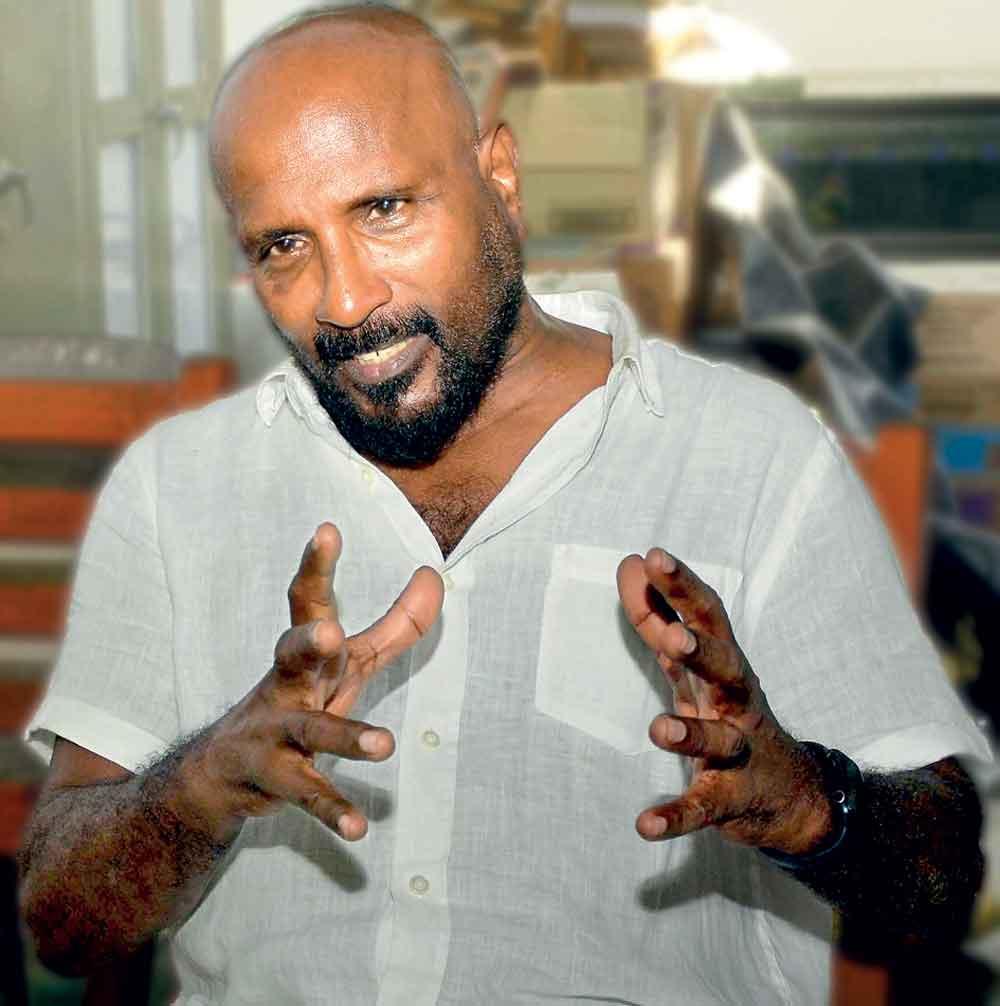
 DAILY MIRROR Former student leader and General Secretary of the Frontline Socialist Party, Kumar Gunaratnam, in an interview with the Daily Mirror, said that there are some contradictions within the students’ unions in the country, but he is hopeful that these unions will come back stronger in the future. He said that President Anura Kumara Dissanayake (AKD) is following the same path as former Presidents such as Ranil Wickremesinghe and has left his leftist ideology behind. He said that AKD has used the JVP brand name to satisfy neoliberalists. Gunaratnam further said that the Party is not worried about its voter base, as he firmly believes it will emerge when the right time and situation arise.
The following are excerpts from the interview.
 Q In a rally held early this year, Propaganda Secretary of the Frontline Socialist Party, Kumar (FSP), stated that it is essential to establish self-governing regions, a bicameral legislature with two houses, and to recognise upcountry Tamils in order to solve the national issue. Don’t you think this itself could lead to many issues in the country?
The short answer is no, because at the last convention held in March, we introduced this programme. We are going to introduce a bicameral legislature system with two houses. One is similar to the present House of Representatives; parallel to that is another house. It is basically equal representation of different nationalities, Such as Sinhala, Tamil and Muslim. The subject matter is different because the second house is planned for making decisions on national and cultural issues. So, even though having the first house, the majority can be a single majority government, but regardless of that, when they have to pass, a resolution, on the basis of national or cultural issues you have to through the second house and get confirmation.
It doesn’t mean we can have complete solutions by introducing this, but to some extent, you can make some decisions; if the first produces a decision with the majority of the Sinhala parliamentarians, you can stop it in the second. When you talk about the upcountry Tamil people- who came here 200 years ago-they were forcefully brought by the British imperialists. Their living conditions are worse than those of other sections of society in the country. That is a well-known fact. Over the years, they have been used by various politicians, not only Sinhala but also Tamil. And they have been used by some nationalist and chauvinist movements. And we believe that, when we consider the national movement in the Northern and Eastern provinces, which had been making demands for decades, it didn’t include the Up-Country Tamil people in its struggle. So we believe that we should find them as a national community. They have been living here for decades.
Therefore, I don’t think that it’s going to be another problem because this is the reality, but it should have been solved in the past, but most of the politicians who ruled the country, the different parties, and the different names, different residents, use this for their sake. Therefore, we propose this programme to address the national issue.
Q Years ago, you were a student leader, and your political language has historically included references to revolution and revolutionary struggles. How do you see student movements at present? Do you think they represent the needs of the hour?
Yes, in the past, the student movement had a great influence in the political arena. But I think it has declined to some extent over the years. At the same time, as a revolutionary party, we believe in the revolution, and we believe in socialism, and we believe in a system change as well.
It is not the system change made by the JVP or NPP, but a real system change. We believe that the working class is the main force for system change. They are the strata; they are the class that possesses power. But the student movement in Sri Lanka has been a kind of radical movement. And they have had a great influence on politics, especially when we consider free education over the last four to five decades. I think they have been fighting to secure education for the masses. So in that sense, I think the students’ movement did a great job in the past.
But at present, after introducing this neoliberal economy, that’s not only the economy, but it’s an ideology as well. This has been unfolding since 1977. Now we are facing the outcomes of the neoliberal economy and what’s happening to society. Today’s society is thinking about itself and is not fighting for others. We have a huge challenge in that regard. I think they are still a strong movement with influence, but at the same time, their influence has been declining for the last few years.
Q: AKD has moved from revolutionary leftist politics to leading a government that operates within the existing state, market, and international financial systems. Do you believe he has betrayed the principles of the Left, or has he simply recognised that those principles cannot govern a modern state in their traditional form?
Yes, I think Anura Kumara Dissanayake, the president, long ago lost his revolutionary conscience. We were in the JVP, and the split happened back in 2011. Prior to that, there had been a long internal argument since 2004, following the formation of the coalition government led by Chandika Bandaranaike. Since 2011, a political debate has been unfolding. And finally, we had to form a political party. Since those days, we have been very clear about our thoughts. I think we call it pragmatism. It means leaving your stance, your policies, and your theoretical basis behind and gradually adopting a pragmatic way of thinking. We are witnessing that reality right now. I don’t think that before being elected as the president, he had any sort of leftist programme in his mind. Even though there was a programme called “pohosath ratak Lassana jeewithayak” (programme for new national renaissance) they had a number of policies, but none of them has been working and not being enacted. AKD is surrounded by people like Duminda Hulangamuwa, Hans Wijesuriya, Dhammika Perera, Ishara Nanayakkara and all other tycoons. He is following the same path as Mr Ranil Wickremesinghe and others. We still believe in a system change and in a better society. Sri Lankan people deserve a better society than this, and a better democratic solution for the problems.
The JVP is not only a name, but also a brand. What Mr Gotabaya Rajapaksa failed to do was to use AKD, the JVP, and the brand created by the sacrifice of several comrades in the past, and to invest it in the neoliberal programme. So the United States of America, or India, or the IMF, the imperialist institutions are content with what is happening in Sri Lanka.
Q You have historically opposed multinational corporations, global finance capital and institutions such as the IMF. But Sri Lanka’s current economic reality is very different from the period when you entered politics. If you were responsible for governing the country today, how would you finance the economy, manage our debts and attract foreign investment without relying on the very institutions and capital you have criticised?
I want to raise one question. Which country was successful in using this IMF programme or the IMF conditions? Look at countries like Greece and Argentina. Even in other countries where the IMF programme was implemented, it failed. On the one hand, we have that reality, because this is not the first time; it’s the 17th time.
According to the Central Bank Governor, we are short of dollars, and according to his explanation, 8.2 billion US dollars is enough to pay debts. We are not going to gain that within a few months.
If we were to handle this situation, we should definitely be supported by the masses. We are not going to separate the masses from the government. If we are going to gain economically, we will do so with the support of the masses. So if you are going to oppose IMF conditions and talk with the bilateral or other institutions about debt servicing, we are going to ask them to conduct audits. What exact amount did we take, and for what?
This is the way we put forward our programme: with the support of the masses. And we are going to impose new taxes, not for the masses, but for some of the capitalists, because they have enough wealth and profit. We are going to introduce new taxes for the top capitalists and release the VAT and the other taxes imposed on the masses. We will continue to fight against these IMF measures. That is one of the major components of our programme.
Q: Does this mean you’re encouraging a participatory governance system? Is that what you’re saying?
Yes, we are very open to saying that our ultimate goal is socialism. There’s no difference. We need to go through a transition period. But how do we go through this period? By getting the support of the masses.
Even though we come to power, we should maintain some organisation amongst the masses, with the workers’ trade unions, peasants and everybody. So they are members. In a participatory democracy, people have a voice on a regular basis, not after five years or after election by election,
Q Don’t you think that itself could create a monopoly where capitalists will get together, and they will find a way to oppress the rest of the masses? When you try to impose tax on these people, don’t you think that the downtrodden masses who work under them will be affected?
Yes, you can argue on that basis. Before AKD became the President, the amount of unpaid taxes was around 1,000 billion, nearly a trillion. What happened to that? Now, after two years in office, do you have any information on whether they have repaid? Look at the tax burden on the masses. They haven’t done anything wrong. They pay whatever taxes are imposed on them. But the top capitalists- I’m not referring to small- or medium-scale entrepreneurs. Indeed, we must support them and strengthen them. To do so, we must give loans with low interest rates. We have to use public banks and restructure them. We also need regulations for some private banks to support small- and medium-scale entrepreneurs. I’m talking about capitalists. While most people pay their taxes, those are the people who didn’t pay their taxes. So there’s a huge difference. That is unjust. That’s why we are saying this is an unjust society,
Once we try to collect taxes from the top capitalists, they will attempt to topple the government. That’s what I’m saying: not only by the votes, but with the organisational power of the masses, we will come together. That is the way we are going to handle office. Whatever actions we take and attempts we make to implement them, we should get support from the masses, who are active partners in this cause. That is the difference between us and other parties.
Q: The NPP has now occupied much of the political space traditionally associated with the Left, while the FSP remains outside Parliament. Has the NPP effectively made the FSP politically irrelevant, or has the FSP failed to adapt to changing political realities?
Yes, I can give you one example. The JVP came to power after 60 years. Until then, they maintained 3% of the vote. Therefore, we don’t worry about our voter base because we know that when the time comes and the situation arises, there will be change. No one expected the aragalaya (Protest) and the birth of the NPP government. The traditional opposition parties criticise the NPP government over the ongoing issue involving judges. The people no longer believe in them due to their past conduct. Whenever they raise an argument against the NPP government regarding this Chief Justice issue, they revert to questions about the appointment of Justice Shirani Bandaranaike.
This is why our stand is stronger, and it affects the government. Throughout history, we were in the JVP. While we were there, we expected a socialist society, but now they have changed all their policies and are taking a pragmatic approach.
We are living in socialism. It doesn’t mean we believe something; this isn’t a religion, and once we believe that, we won’t give up. This is the only scientific alternative. When I ask, do you like this society? Do you like this inequality? Do you like these IMF-imposed conditions? Do you like these taxes? Do you like the social environment? Do you like these ethnic issues? Now, do you like these religious contradictions and conflicts? We need to change it. So that is called socialism.
We have learnt a lot from the Soviet Union and other socialist countries, especially in Eastern Europe, as well as from China. They have changed this society a lot. But still, we have learned a lot, and we need to implement a new socialist programme.
Q You emphasised the phrase ‘being pragmatic’. Do you mean AKD is being pragmatic?
I said pragmatism. Being pragmatic is good. But pragmatism is not good because it leads you to fall into circumstances. You don’t have a strategy. You don’t have a plan, a long-term plan. Whatever situation arises, you fall into that. So that is called pragmatism. Then you don’t have a clear vision. The word Pragmatic is good because, depending on the situation, even though you have a plan, a vision, and a strategic programme, you still have to be practical. So that is a different thing. Pragmatism is totally different. You don’t have a vision.
Q: Would you support an alliance formed by the opposition parties if the objective is to defeat the NPP-led government? If not, why?
We are not going to form an alliance with the traditional parties, the SJB, or any other parties, because we have had enough experience with them in the past, and they haven’t changed anything regarding the economy or democracy. Now, since NPP is in power, they have an opportunity. They used to criticise the governments in the past. They criticised the neoliberal economy and education reforms. The very people who criticised them are following the same. This means the former parties that were in power can justify their past actions. They can justify their economic policy and the prevention of terrorism and other anti-democratic laws. And they can justify their intervention in the judicial system. Who is giving oxygen to the parties who were defeated by the people, the same NPP and AKD government?
But the reason we try to implement our programme ourselves doesn’t mean we don’t have any others. It is because there’s no party or type of group that we can deal with. We have experience with the parties that were in power and with the NPP now. Even though they are criticising each other on policy and democracy, they are following the same path. Therefore, we should find a different path. We should follow our own path and organise and mobilise people towards a progressive society.

